
Blog
Beyond the Dashboard: The Shift to Conversational Enterprise Intelligence
For decades, Australian businesses have relied on dashboards to understand what is happening across their operations. Colourful charts, KPI gauges and sales graphs have become a familiar part of the modern workplace.
But what happens when a business leader needs an answer that isn’t already sitting inside a dashboard?
For example:
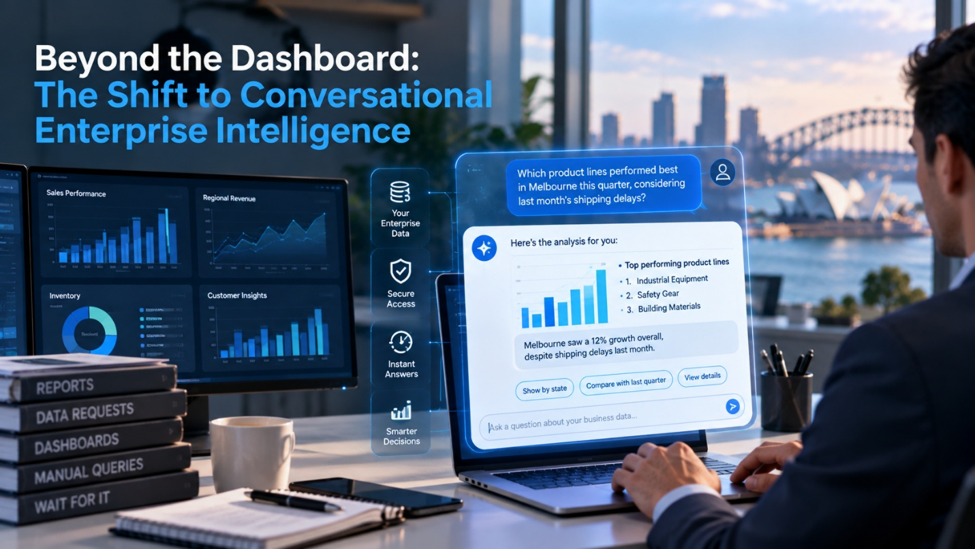
“Which product lines performed best in Melbourne this quarter, considering last month’s shipping delays?”
A traditional dashboard may not have the answer. The user may need to request a custom report, wait for the data team, or attempt to write a database query themselves.
This is where conversational enterprise intelligence is changing the way businesses interact with data.
Instead of navigating dozens of dashboards or relying on technical teams for every question, employees can increasingly interact with enterprise data using natural language—much like having a conversation with a colleague.
Why Traditional Business Dashboards Are No Longer Enough
Australian organisations generate enormous volumes of information every day—from customer transactions and inventory records to financial data, support tickets and operational metrics.
The challenge isn’t simply collecting data. It is accessing and understanding that data quickly enough to make better decisions.
In many organisations, business information remains stored across relational databases, cloud platforms and data warehouses. When someone needs an ad-hoc insight, the process can look like this:
- The request: A manager needs specific information for a meeting.
- The queue: The request goes to the IT, analytics or data team.
- The Wait: The team extracts and prepares the information.
- The answer: By the time the report arrives, the business situation may have changed.
This creates friction between having data and actually using it.
Dashboards remain valuable for monitoring established KPIs, but they are not always designed to answer every new question a business may have.
What Is Conversational Enterprise Intelligence?
Conversational enterprise intelligence allows people to interact with business data using natural language instead of technical database queries.
A database AI agent acts as an intelligent intermediary between business users and enterprise data. Rather than requiring employees to understand SQL or navigate complex reporting systems, the user can simply ask a question in plain English.
For example:
- “Which Queensland clients haven’t placed an order in the last 60 days?”
- “What is our inventory turnover for SKU-4092 across Victorian locations?”
- “Summarise last week’s support tickets by severity.”
- “Which products experienced the biggest decline in sales this quarter?”
The database AI agent interprets the request, works with authorised enterprise data and returns the relevant information in an understandable format.
The experience shifts from:
“Find the right dashboard.”
to:
“Ask the right question.”
How Does a Database AI Agent Work?
The concept is simpler than it may sound.
1. Ask
A business user asks a question using everyday language.
2. Understand
The AI agent interprets the request and identifies what information is required.
3. Query
The agent interacts with the relevant enterprise data within the user’s authorised access.
4. Analyse
The retrieved information is processed to answer the business question.
5. Respond
The user receives a clear response without having to manually build a report or write a database query.
Modern Microsoft technologies such as Microsoft Copilot Studio, Azure SQL and Microsoft Fabric can form part of this conversational data ecosystem.
The result is a more natural bridge between people and enterprise information.
Database AI Agent vs Traditional Dashboard
| Traditional Dashboard | Database AI Agent |
| Uses predefined reports | Answers natural-language questions |
| Designed around fixed KPIs | Supports ad-hoc questions |
| Users navigate multiple screens | Users interact conversationally |
| New reports may require technical support | Business users can ask questions directly |
| Often requires dashboard maintenance | Reduces dependence on dashboards for niche queries |
| Information is presented through predefined visualisations | Information can be presented as a direct business response |
The goal isn’t necessarily to eliminate dashboards.
Instead, conversational intelligence can complement dashboards by making enterprise data easier to explore.
Why Australian Businesses Are Moving Towards Conversational Data
1. Faster Access to Business Insights
Business decisions often depend on timing.
A sales leader preparing for a meeting, a logistics manager checking inventory or a finance team investigating an unexpected variance may need information immediately.
Conversational access can reduce the friction between asking a question and obtaining an answer.
2. Democratise Data Across Departments
Data shouldn’t be accessible only to people who understand databases or analytics tools.
With a database AI agent, teams across sales, finance, operations, customer service and supply chain can interact with authorised business information using natural language.
This can help employees become more self-sufficient while allowing data specialists to focus on higher-value analytical work.
3. Reduce Dashboard Fatigue
Many organisations accumulate dashboards over time.
One dashboard monitors sales. Another tracks inventory. Another covers customer service. Another focuses on finance.
Eventually, users can spend more time finding the right dashboard than analysing the information.
Conversational AI offers another approach: instead of creating a new dashboard for every possible question, users can ask the system directly.
4. Bring Intelligence Into Existing Workflows
Enterprise technology becomes more useful when it fits naturally into the tools employees already use.
Microsoft-based conversational solutions can integrate into familiar business environments, including Microsoft Teams, allowing employees to access information without constantly switching between applications.
Security, Governance and Trust
Introducing AI into enterprise databases requires more than convenience. Security and governance are essential.
A database AI agent should respect existing permissions and ensure that users can access only the information they are authorised to see.
Technologies such as Microsoft Entra ID and Role-Based Access Control (RBAC) can help establish these boundaries.
For example, an employee who does not have permission to access sensitive payroll or financial information should not gain access simply because they phrase a question differently.
Enterprise-grade AI can also support controlled database operations, audit logging and human approval processes for sensitive changes.
This creates an important balance:
Natural-language simplicity for employees.
Enterprise-grade governance for organisations.
From Business Intelligence to Business Conversation
The broader shift is not simply about replacing charts with chat.
It represents a change in how people interact with information.
For years, businesses adapted themselves to the language of technology: databases, queries, reports, filters and dashboards.
Conversational enterprise intelligence begins to reverse that relationship.
Technology increasingly adapts to the way people naturally communicate.
The question is no longer:
“Which report contains the answer?”
It becomes:
“What do I need to know?”
That distinction can have a significant impact on how quickly organisations discover insights and respond to changing business conditions.
The Future of Conversational Enterprise Intelligence
Dashboards aren’t disappearing. They remain highly useful for monitoring performance, tracking KPIs and communicating established metrics.
But the next generation of enterprise intelligence is likely to be more interactive, conversational and accessible.
For Australian businesses, the opportunity is to move beyond simply accumulating data and focus on making that data easier to understand and act upon.
A database AI agent can help bridge the gap between complex enterprise databases and everyday business users—allowing teams to ask questions, explore information and make data-driven decisions using natural language.
The future of business intelligence may not be another dashboard.
It may be a conversation.
Ready to Move Beyond Traditional Dashboards?
If your teams spend too much time searching for reports, waiting for data extracts or relying on technical specialists for routine business questions, conversational AI can provide a more flexible way to interact with enterprise data.
Explore Compusoft Advisors’ Database AI Agent to discover how conversational access to enterprise data can support smarter, faster and more accessible business intelligence.